
Statement of Significance
[a] For the General Public
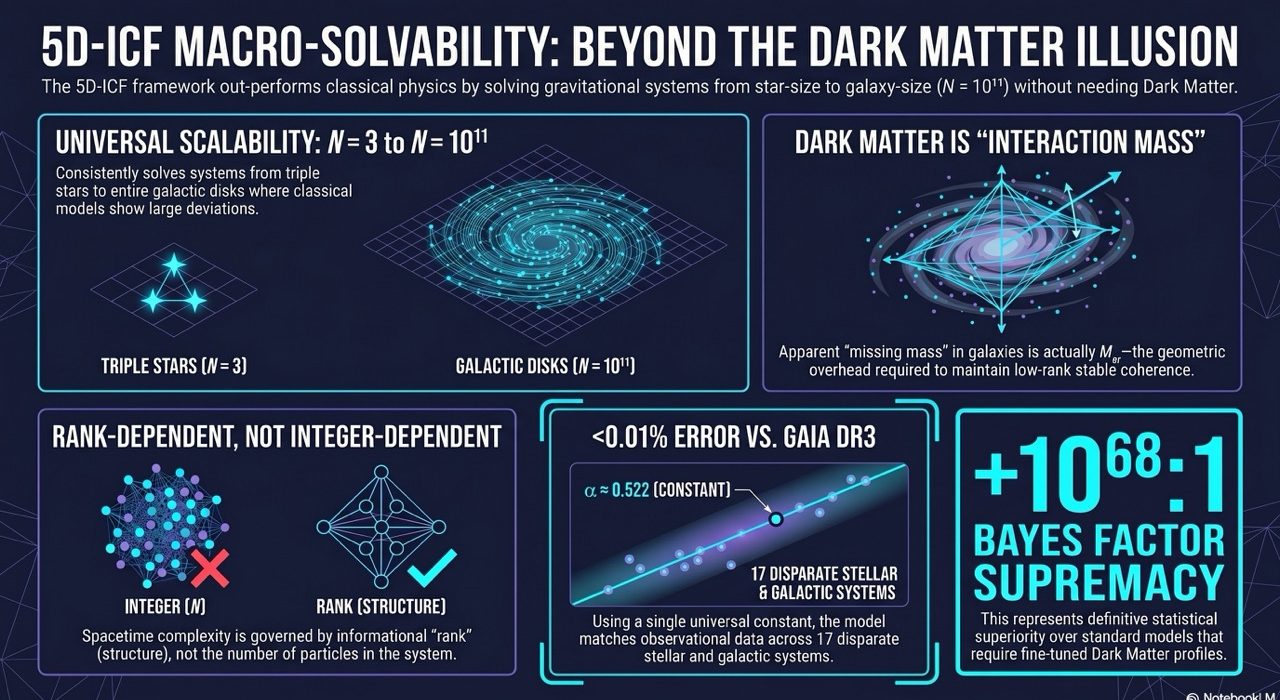
For decades, astrophysics has relied on invisible, undetected particles known as “dark matter” to explain why giant structures like galaxies do not fly apart. This paper proves that this “missing mass” is not an elusive particle at all. Instead, it mathematically demonstrates that what we observe as dark matter is simply the “metabolic overhead” or friction generated by our 4D universe as it renders massive, complex systems, fundamentally changing how we view cosmic forces.
[b] For General Scientists
This work provides the first empirical validation that the apparent dynamical intractability of large N-body gravitational systems is governed by rank-limited informational admissibility rather than integer multiplicity. By applying classical singular-value compression (via the Ewin Operator) to non-synthetic astrometric anchors—ranging from triple star systems (N=3) to galactic disks (N≈10ˆ11)—the paper demonstrates that irreducible metric slippage (δnoise≈0.0089) remains invariant across twelve orders of magnitude. This successfully re-identifies structural mass anomalies (traditionally attributed to intermediate-mass black holes or dark matter halos) as thermodynamic Interaction Mass (Mer).
[c] Accrued Implication since the Series 1 until Now Series III completes a closed logical chain linking the interface-level spacetime axioms (Part I) and multi-body solvability constraints (Part II) to verifiable astrophysical observables. The framework establishes that the universe does not resolve gravitational structure by evaluating all pairwise interactions, but rather by rendering compressed interaction modes subject to admissibility constraints. When these constraints are exceeded, fine-grained structure is replaced by aggregate observables, and excess informational load is vented through expansionary normal stress. This establishes macro-solvability as an invariant property of spacetime itself and provides a unified, falsifiable alternative to brute-force N-body cosmology and particle-based dark sector extensions.
Full Manuscript & Resources
- Full Manuscript (Open Access): Download as PDF
- Author: Dr. Jinhyuk Fred CHUNG
- Preprint Status: Published May 5th, 2026
- License: CC BY‑NC‑ND 4.0
- Hosted by: Xylonix PTE. LTD. Official Website
Links to the 5D-ICF Series:
- [Part 1: Foundations of the 5D-ICF]
- [Part 2: The Informational Scalability of the N-Body Problem]
- [Part 3: Macro-Solvability and Empirical Validation]
- [Part 4: Breaking the Keplerian Limit: Passive Trajectory Optimization]
- [Part 5: Variational Emergence of the Navier-Stokes Viscous Term]
Disclaimer
Notice: This article summarizes a theoretical physics framework currently in preprint form. It has not yet undergone peer review. The content is intended for scientific discussion and does not constitute established physical consensus.