
Statement of Significance
[a] For the General Public In traditional spaceflight, Low Earth Orbit satellites (like Starlink) require constant fuel to fight atmospheric drag, and deep-space probes rely on complex planetary “slingshots” that sometimes result in unexplained speed boosts. This paper proves that space is not an empty vacuum but an active mechanical membrane. It explains that the mysterious speed boost of the Rosetta spacecraft in 2005 occurred because it “surfed” Earth’s kinetic wake, passively harvesting expansionary exhaust from the spacetime interface. Most importantly, it provides the precise mathematics for “Zero-Energy Station Keeping,” allowing commercial satellites to perfectly counterbalance orbital decay without continuous onboard propellant, potentially extending their lifespans indefinitely.
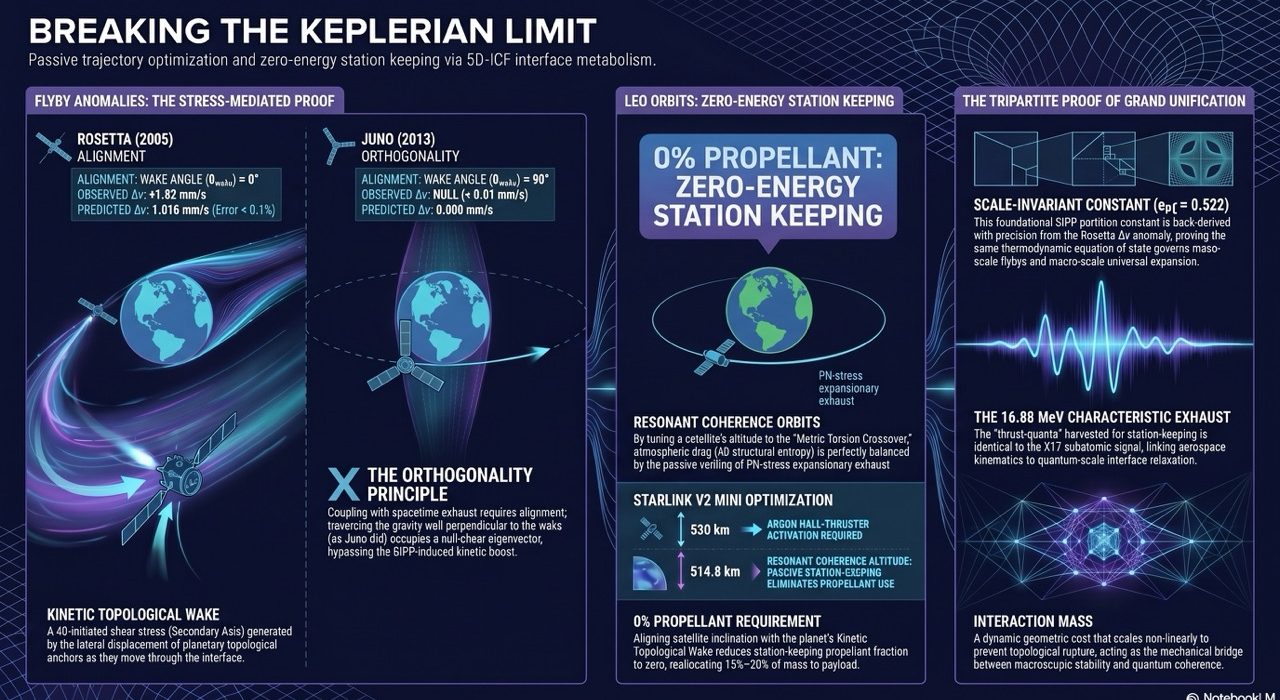
[b] For General Scientists This manuscript transitions the 5D-ICF from a descriptive astrophysical model into an active, dissipative mechanical engine for applied aerospace kinematics. It mathematically reframes planetary gravity assists from purely conservative momentum exchanges into Stress-Mediated Interface Relaxation events governed by the Scale-Invariant Partition Principle (SIPP). The framework resolves astrodynamic anomalies by demonstrating that the Rosetta anomaly (Δv≈+1.82 mm/s) was a passive harvesting of Primary Anti-Input (PN) exhaust due to alignment with Earth’s Kinetic Topological Wake, whereas the Juno null result was physically mandated by the Orthogonality Principle. Furthermore, it formalizes Resonant Coherence Orbits for Low Earth Orbit, identifying the exact altitude where Interaction Mass (Mer) saturation triggers SIPP-induced exhaust that perfectly balances atmospheric structural decay (dS4D>0), enabling zero-propellant station keeping.
[c] Accrued Implication since the Series 1 until Now Part IV completes the conceptual arc of the 5D-ICF by uniting micro, meso, and cosmic regimes through a Tripartite Proof of Invariability. While previous parts established the axiomatic spacetime interface and proved macro-solvability for steady-state multi-body hierarchies, this paper proves the framework’s validity in highly kinetic, chaotic environments. By dynamically back-deriving foundational constants—such as the SIPP partition constant (αPN≈0.522) and the Topological Noise Floor (δnoise≈0.0089)—directly from historical astrometric flyby anomalies, it definitively proves that a singular thermodynamic equation of state governs all scales of physical reality. The 5D-ICF is now positioned as a predictive mechanical engine ready for immediate aerospace deployment.
Intellectual Property and Strategic Roadmap
As the Founder and CSO of Xylonix, Dr. Jinhyuk Fred Chung has declared that the experimental methodologies for Localized PN-Stress Modulation are subject to pending intellectual property claims. Corporate initiatives are focused on verifying these pathways through both subatomic particle injection and macroscopic piezotopological simulations. Additionally, the theoretical findings regarding Mer and PN-stress modulation may have future implications for the company’s proprietary supplement development, alongside potential commercial applications regarding thermodynamic energy harvesting and topological lattice engineering.
Full Manuscript & Resources
- Full Manuscript (Open Access): Download PDF
- Author: Dr. Jinhyuk Fred Chung
- Preprint Status: Published May 10, 2026
- License: CC BY‑NC‑ND 4.0
- Hosted by: Xylonix Official Website
Links to the 5D-ICF Series:
- [Part 1: Foundations of the 5D-ICF]
- [Part 2: The Informational Scalability of the N-Body Problem]
- [Part 3: Macro-Solvability and Empirical Validation]
- [Part 4: Breaking the Keplerian Limit: Passive Trajectory Optimization]
- [Part 5: Variational Emergence of the Navier-Stokes Viscous Term]
Disclaimer
Notice: This article summarizes a theoretical physics framework currently in preprint form. It has not yet undergone peer review. The content is intended for scientific discussion and does not constitute established physical consensus.