
Statement of Significance
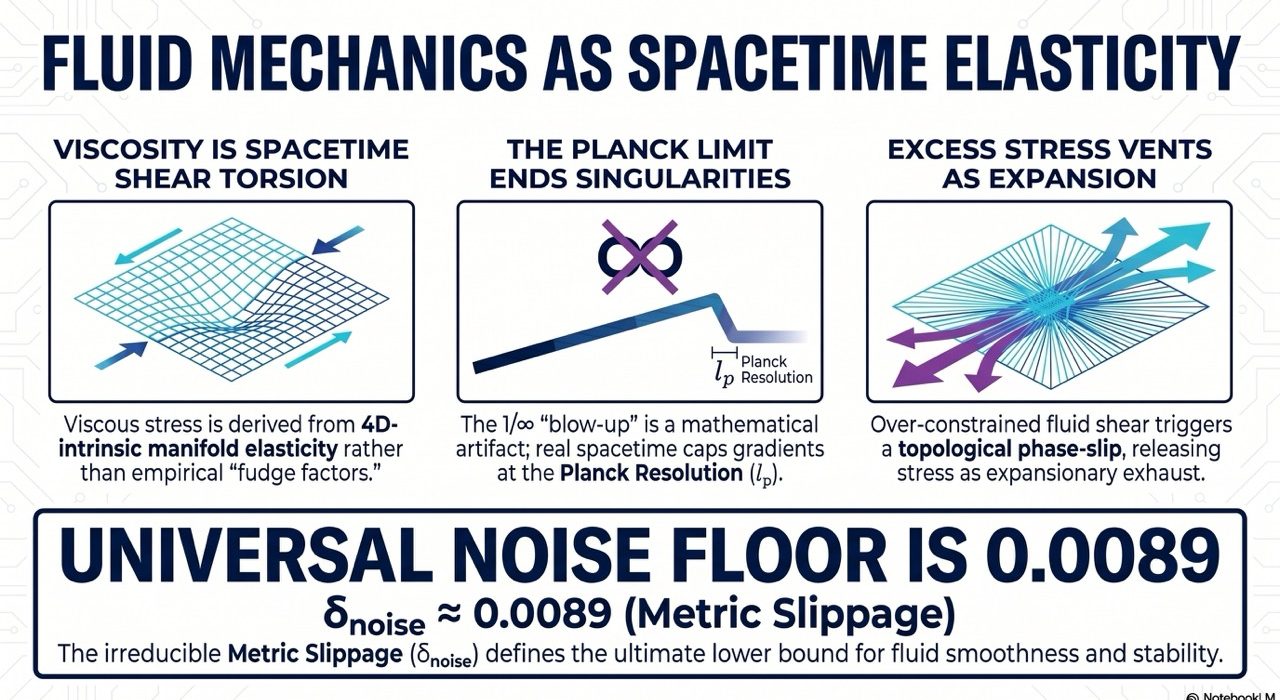
[a] For the General Public One of the most famous math puzzles in the world, the Navier-Stokes Millennium Problem, asks if fluid flows (like water or air) can become infinitely chaotic and mathematically “blow up.” This paper proves that these impossible infinities only happen on paper because traditional math assumes space is an infinitely divisible, continuous void. In reality, spacetime acts like a flexible but finite “shock absorber”. Before a fluid can reach infinite turbulence, the universe’s built-in hardware limits kick in, forcing the excess stress to safely vent as expansionary exhaust. This physically prevents catastrophic singularities, guaranteeing that all physical fluids must always flow smoothly.
[b] For General Scientists This manuscript provides an axiomatic resolution to the Navier-Stokes smoothness problem by deriving the viscous term as a geometric shear response of a finite-elasticity spacetime interface. Classical continuum limits ($l_p \to 0, \kappa \to \infty$) create mathematical artifacts resulting in finite-time singularities. By rendering the fluid dynamics on the Dimensional Interface Model (DIM) governed by the Planck Resolution Kernel ($\mathcal{R}(l_p)$) and the Topological Bulk Modulus ($\kappa$), unbounded shear growth is physically excluded. As localized stress approaches the elastic limit, the interface undergoes a mandatory phase-slip into expansionary PN-Stress exhaust, predicting a testable “Spectral Plateau” where classical power-law decay transitions into a coherent residual flux.
[c] Accrued Implication since the Series 1 until Now Part V serves as a critical bridge between macroscopic applied kinematics and fundamental mathematical admissibility within the 11-part 5D-ICF architecture. Building upon the steady-state N-body solutions (Parts I-III) and orbital mechanics (Part IV), this paper proves that fluid dynamics obey the exact same thermodynamic metabolism (Net-Zero Entropy Postulate) that governs the cosmos. This sets the stage for the mathematical and quantum unifications that follow in later papers. Rejecting this finite-elastic closure carries a massive cross-scale cost: a critic must insist that spacetime is infinitely divisible and perfectly rigid, thereby unraveling the unified mechanics that resolve Dark Matter halos, spacecraft flyby anomalies, and universal expansion.
Intellectual Property and Strategic Roadmap
As the Founder and CSO of Xylonix, Dr. Jinhyuk Fred Chung has declared that the experimental methodologies for Localized PN-Stress Modulation are subject to pending intellectual property claims. Corporate initiatives are focused on verifying these pathways through both subatomic particle injection and macroscopic piezotopological simulations.
Full Manuscript & Resources
- Full Manuscript (Open Access): Download PDF
- Author: Jinhyuk Fred CHUNG, PhD
- Preprint Status: Published 11th May 2026
- License: CC BY‑NC‑ND 4.0
- Hosted by: Xylonix Official Website
Links to the 5D-ICF Series:
- [Part 1: Foundations of the 5D-ICF]
- [Part 2: The Informational Scalability of the N-Body Problem]
- [Part 3: Macro-Solvability and Empirical Validation]
- [Part 4: Breaking the Keplerian Limit: Passive Trajectory Optimization]
- You are here ->[Part 5: Variational Emergence of the Navier-Stokes Viscous Term]