
By Dr. Jinhyuk Fred CHUNG, PhD (Founder & CSO, Xylonix)
Statement of Significance
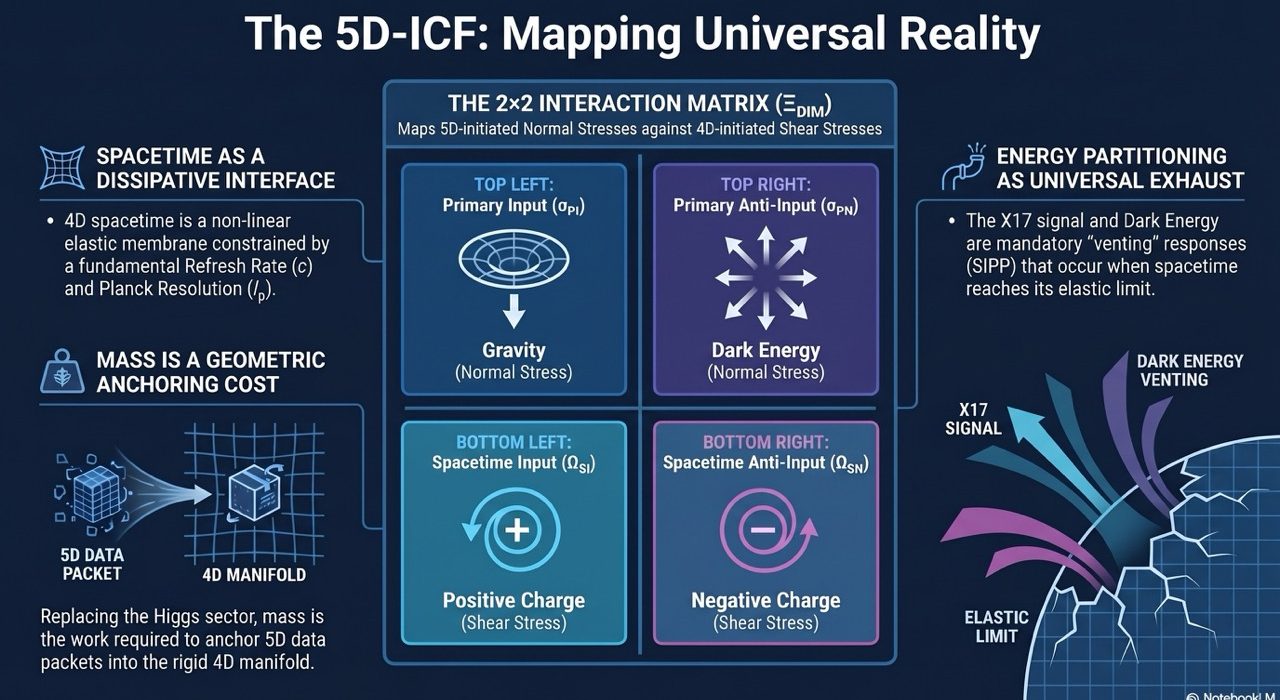
[a] For the General Public Current physics often treats the universe as a passive, empty container where fundamental particles interact. This foundational paper proposes a radical shift: our 4D spacetime is actually an active, elastic “membrane” (or interface) that physically processes information. When this membrane is stressed or stretched to its limits, it must react. This framework successfully explains the universe’s most profound mysteries—such as Dark Energy (the membrane’s stretching tension), Dark Matter (informational rendering friction), and mass itself—as natural, mechanical responses of spacetime, completely eliminating the need to invent invisible, undetected particles.
[b] For General Scientists This manuscript establishes the ontological baseline for the 5D Interference-Coherence Field (5D-ICF), treating the Standard Model as an effective field theory operating on a finite-elasticity spacetime substrate. It supersedes classical fundamental forces with a 2 × 2 Symmetry Matrix mapping macroscopic gravity and gauge interactions as orthogonal normal and shear stresses. Furthermore, it replaces the scalar Higgs field by deriving fermion mass geometrically through a topological anchoring cost (nf) on the SU(2) manifold, achieving 99.78% accuracy for the top-quark mass. By introducing the Scale-Invariant Partition Principle (SIPP), the framework derives the 16.88 MeV X17 signal, the cosmological Lithium-7 deficit, and the Hubble Tension not as breakdowns of current theory, but as mandatory thermodynamic exhaust and non-perturbative interface relaxation responses.
[c] Accrued Implication since the Series 1 until Now As the foundational manuscript of the series, Part I establishes the core axiomatic architecture—the Dimensional Interface Model (DIM)—that makes the subsequent macroeconomic and multi-body proofs possible. By defining the universe’s Thermodynamic Hardware and establishing a Boundary Equation of State, it anchors the entire framework. It logically sets the stage for Series II and III to eventually prove that the computational intractability of the N-body problem, apparent mass anomalies, and macroscopic expansion are all unified, scale-invariant properties of spacetime rendering, rather than particle-based dark sector phenomena.
Intellectual Property and Strategic Roadmap
As the Founder and CSO of Xylonix, Dr. Jinhyuk Fred Chung has declared that the experimental methodologies for Localized PN-Stress Modulation are subject to pending intellectual property claims. Corporate initiatives are focused on verifying these pathways through both subatomic particle injection and macroscopic piezotopological simulations.
Technical Reference: Chung, J. F. (2026). Foundations of the 5D Interference-Coherence Field (5D-ICF): A Topological Architecture for Grand Unification.
Full Manuscript & Resources
- Full Manuscript (Open Access): Download PDF
- Author: Dr. Jinhyuk Fred CHUNG
- Preprint Status: Published May 5th, 2026
- License: CC BY‑NC‑ND 4.0
- Hosted by: Xylonix Official Website
Links to the 5D-ICF Series:
- [Part 1: Foundations of the 5D-ICF]
- [Part 2: The Informational Scalability of the N-Body Problem]
- [Part 3: Macro-Solvability and Empirical Validation]
- [Part 4: Breaking the Keplerian Limit: Passive Trajectory Optimization]
- [Part 5: Variational Emergence of the Navier-Stokes Viscous Term]
Disclaimer
Notice: This article summarizes a theoretical physics framework currently in preprint form. It has not yet undergone peer review. The content is intended for scientific discussion and does not constitute established physical consensus.