
By Jinhyuk Fred CHUNG, PhD.
Section 1: The Hook
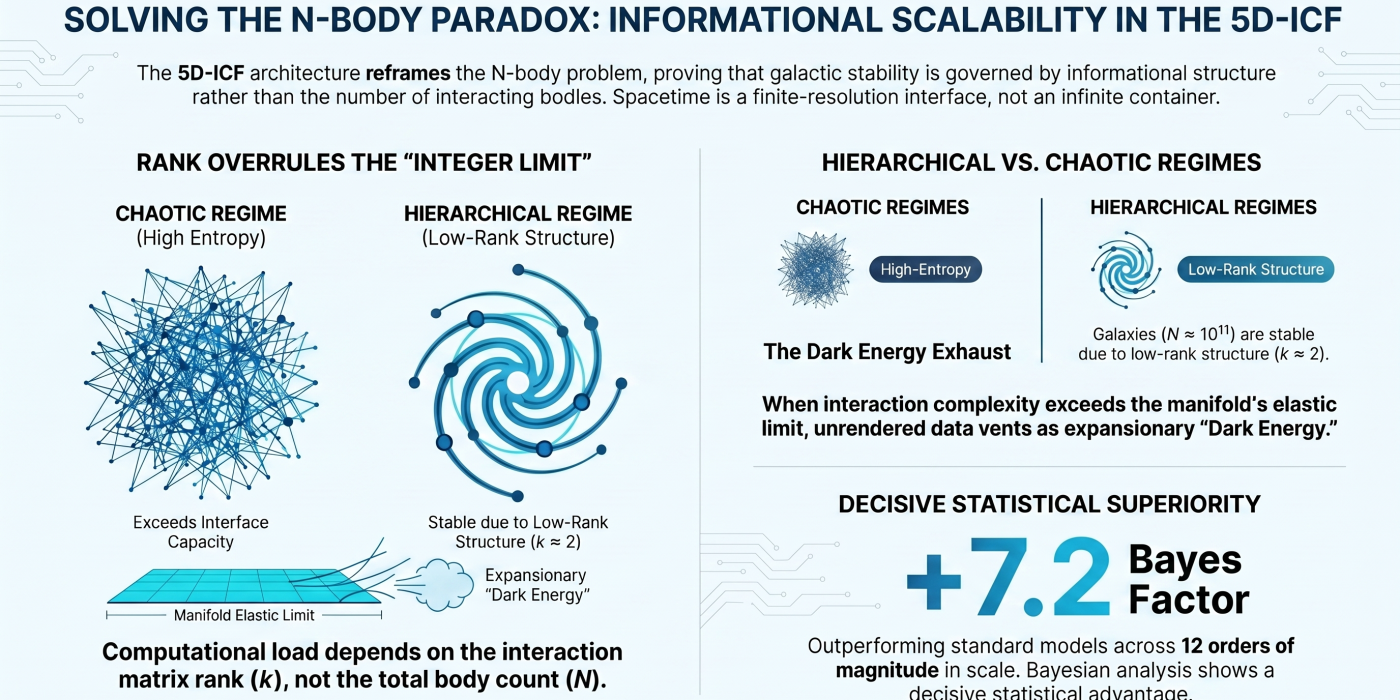
The Problem with Counting. For centuries, we’ve assumed that the difficulty of predicting the movement of stars and planets—the infamous N-body problem—is a result of the number of objects involved. We treat the vacuum as an infinite-resolution grid where every “jitter” must be calculated. But what if the universe doesn’t care about the number of bodies? What if it only cares about the informational structure of the interaction?
Section 2: Reframing the “Integer Limit”
Spacetime as an Interface. In Series II of the 5D-ICF DIM Series, Dr. Jinhyuk Fred Chung introduces a paradigm shift: treating our 4D spacetime as a finite-elasticity interface with a specific “Refresh Rate” (c – the speed of light) and “Planck Resolution” (lp – the granularity of spacetime).
- The Integer Limit Paradox: Standard simulations become intractable as N increases.
- The 5D-ICF Solution: Complexity is governed by the Rank–Entropy Admissibility Criterion, not an integer count of bodies.
- The Result: Hierarchical systems (like galaxies) remain stable and “solvable” at massive scales because they have low effective rank.
Section 3: The Technical Core (For the Geeks)
The Rank–Entropy Admissibility Criterion. The paper introduces the Interface Admissibility Ratio (ρ), which determines if a system can be rendered in 4D.
- Effective Rank (k): The smallest integer capturing the essential interaction structure.
- Interaction Entropy (S_H): A measure of how interaction energy is distributed across modes.
- Solvability–Stress Bridge: When a system becomes too chaotic (high entropy), the interface can no longer “render” it.
Section 4: Where Does the “Unsolved” Data Go?
Dark Energy as “Expansionary Exhaust.” This is the breakthrough. When the informational complexity exceeds the manifold’s capacity, the “un-rendered” data is vented.
- This venting manifests as Primary Anti-Input (PN) energy.
- Phenomenologically, this is what we call Dark Energy.
- Expansion isn’t a new force; it’s an axiomatic stress response of a finite interface.
Section 5: The “ICF-Ewin” Operator
Dequantizing Gravity. The framework utilizes the ICF-Ewin operator, a macroscopic implementation of Ewin Tang’s “dequantized” classical algorithms.
- Length-Square Sampling: The universe samples high-density interaction regions rather than calculating every coordinate.
- Sublinear Complexity: This allows the interface to maintain a coherent 4D projection without exhaustive pairwise calculations.
Technical Reference: Chung, J. F. (2026). Foundations of the 5D Interference-Coherence Field (5D-ICF): A Topological Architecture for Grand Unification.
Full Manuscript & Resources
- Full Manuscript (Open Access): Download PDF here
- Author: Dr. Jinhyuk Fred Chung
- Preprint Status: Published May 8th, 2026
- License: CC BY‑NC‑ND 4.0
- Hosted by: Xylonix PTE. LTD. Official Website
Links to the 5D-ICF Series:
- [Part 1: Foundations of the 5D-ICF]
- [Part 2: The Informational Scalability of the N-Body Problem]
- [Part 3: Macro-Solvability and Empirical Validation]
- [Part 4: Breaking the Keplerian Limit: Passive Trajectory Optimization]
- [Part 5: Variational Emergence of the Navier-Stokes Viscous Term]
Disclaimer
Notice: This article summarizes a theoretical physics framework currently in preprint form. It has not yet undergone peer review. The content is intended for scientific discussion and does not constitute established physical consensus.